
Ibn al-Jazarī › Quarter-gear machine › Build the model
Free · paper model & 3D print · Category V, Chapters 1–2
Build al-Jazarī's quarter-gear water machine
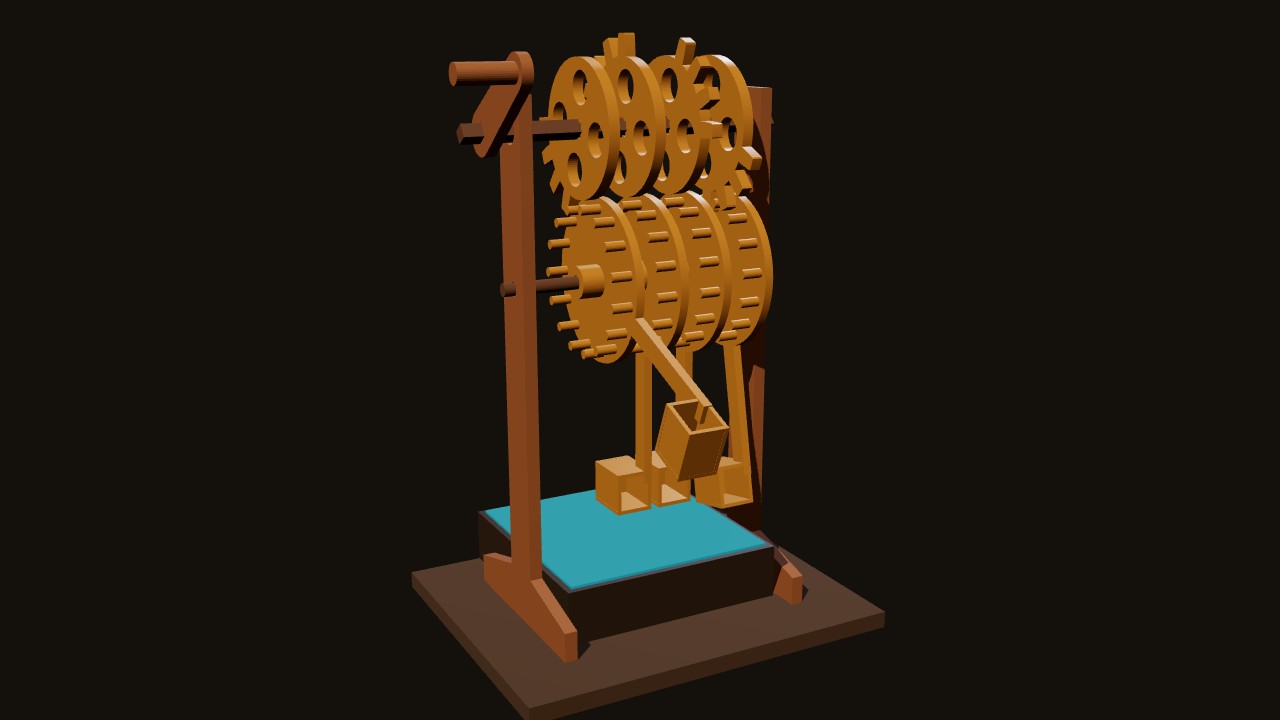
A desk model of the machine al-Jazarī described in 1206. Turn the crank: a gear with teeth on only a quarter of its rim lifts a ladle, then lets it fall. Put four on one axle, a quarter turn apart, and one ladle is always rising.
What you'll make
The model keeps al-Jazarī's own parts: a quarter-wheel with four teeth on one quarter of its rim, a runged (lantern) wheel below it, and a ladle fixed to the lower axle. In place of the animal on the upper deck, you turn a crank. The square upper axle is the trick for the four-ladle version: slide each quarter-wheel on turned 90° from the last, and their teeth come round one after another.
Downloads
| Download | Size |
|---|---|
| Cut-out templates and instructions (PDF, 4 pages, Letter/A4) al-jazari-quarter-gear-build-kit.pdf | 110 KB |
| All STL files for 3D printing (ZIP) al-jazari-quarter-gear-stl-files.zip | 64 KB |
| Quarter-wheel · print 4 al-jazari-quarter-wheel-x4.stl | 164 KB |
| Runged wheel with ladle · print 4 al-jazari-runged-wheel-with-ladle-x4.stl | 146 KB |
| Side frame · print 2 al-jazari-side-frame-x2.stl | 21 KB |
| Crank · print 1 al-jazari-crank-x1.stl | 39 KB |
You need
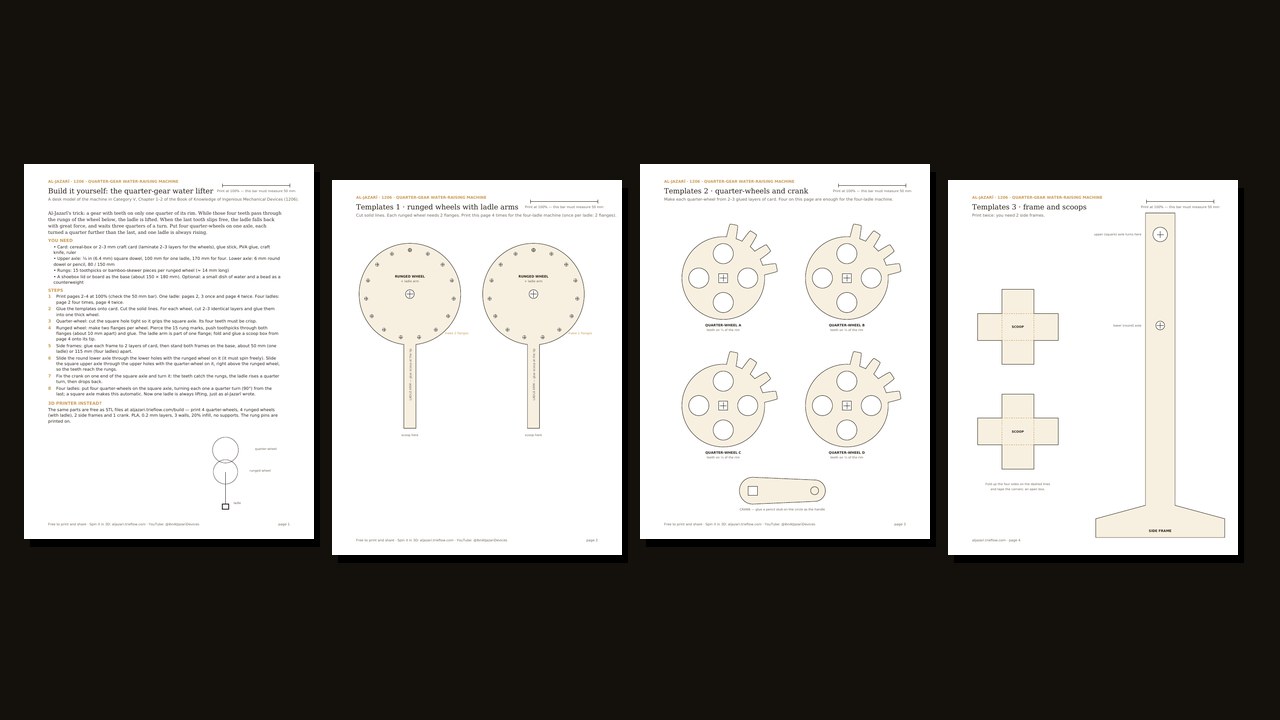
- Paper model: card or cereal-box cardboard, glue, a craft knife and ruler, 15 toothpicks per runged wheel.
- 3D print: PLA, 0.2 mm layers, 3 walls, 20% infill, no supports. The rung pins print in place. The frame is 242 mm tall: print it diagonally on a small bed.
- Axles: a ¼ in (6.4 mm) square dowel on top, a 6 mm round dowel below, plus a small board as the base and, if you like, a shallow dish of water under the scoops.
Steps
- Print or 3D-print the parts. Print the PDF templates at 100% (check the 50 mm bar) and glue them to card, or 3D-print the STL files: 4 quarter-wheels, 4 runged wheels with ladles, 2 side frames and 1 crank.
- Make the wheels. Cut each wheel from 2–3 glued layers of card. Keep the quarter-wheel teeth crisp and cut its square hole tight.
- Fit the rungs. Push 15 toothpicks through both flanges of each runged wheel to make a lantern wheel. Printed wheels already have their pins.
- Stand the frames. Glue the two side frames to a base board, about 50 mm apart for one ladle or 115 mm for four.
- Fit the lower axle. Slide the 6 mm round dowel through the lower holes with the runged wheels on it; they must swing freely.
- Fit the upper axle. Slide the ¼ in square dowel through the upper holes with the quarter-wheels on it, each turned a quarter turn from the last, right above the runged wheels.
- Turn the crank. Fix the crank to the square axle and turn it. Each quarter-wheel lifts its ladle for a quarter turn and lets it fall; with four, one ladle is always rising.
Why it works
The quarter-wheel's four teeth are spaced exactly like the rungs below (16 tooth positions against 15 rungs), so while they pass through the rungs the lower axle turns and the ladle swings up. When the last tooth slips free nothing holds the ladle: in al-Jazarī's words, it “descends again to the pool with great force”. With one wheel the ladle is idle for three quarters of every turn. With four, each a quarter turn round from the last, as one ladle lets go the next tooth takes hold, and the crank, like al-Jazarī's animal, pulls a steady load.
Made one?
Show us your build
Post it in the comments under the film on YouTube. More of al-Jazarī's machines, with models to build, are on the way.