
Book of Knowledge · Category V, Chapters 1 & 2 · 1206
Al-Jazarī's quarter-gear water-raising machine, explained in 3D
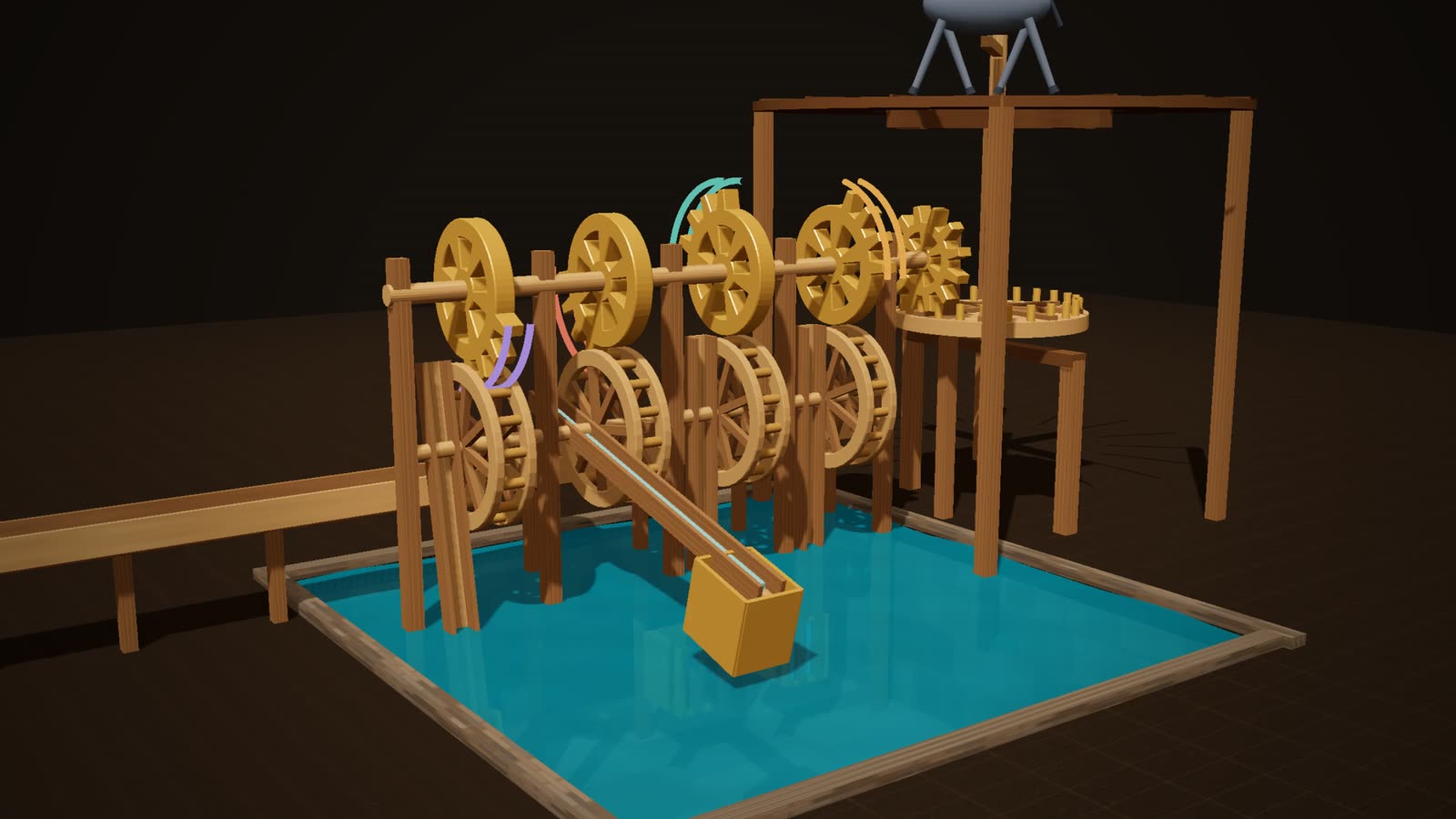
In 1206 the engineer Ibn al-Razzāz al-Jazarī described a machine that lifts water from a pool using a gear with teeth on only a quarter of its rim. Then he improved it: four of those gears on one axle, so the water never stops flowing. Explore it below in interactive 3D, part by part, beside his own drawing.
Who was al-Jazarī?
Ismāʿīl ibn al-Razzāz al-Jazarī spent some twenty-five years as an engineer at the court of the Artuqid rulers of Diyar Bakr in Upper Mesopotamia, at the city of Amid, today's Diyarbakır. In 1206 he finished The Book of Knowledge of Ingenious Mechanical Devices (Kitāb fī maʿrifat al-ḥiyal al-handasiyya): fifty machines, from water clocks and drinking automata to fountains, locks and pumps. He was careful to include only machines he had built himself, each with a lettered drawing and instructions for making it.
Five of the fifty raise water, from pools, from shallow wells and from running streams. This page follows the first two, in Category V of the book: a machine with one ladle, and its upgrade with four.
Before al-Jazarī: the shaduf
For thousands of years, irrigation water was lifted with the shaduf: a long pole on a pivot, a counterweight on one end and a bucket on the other. It works, but a person has to haul every single bucket. Al-Jazarī kept the idea of a swinging lifting arm and handed the work to an animal and a train of gears.
Chapter 1: the single-ladle machine
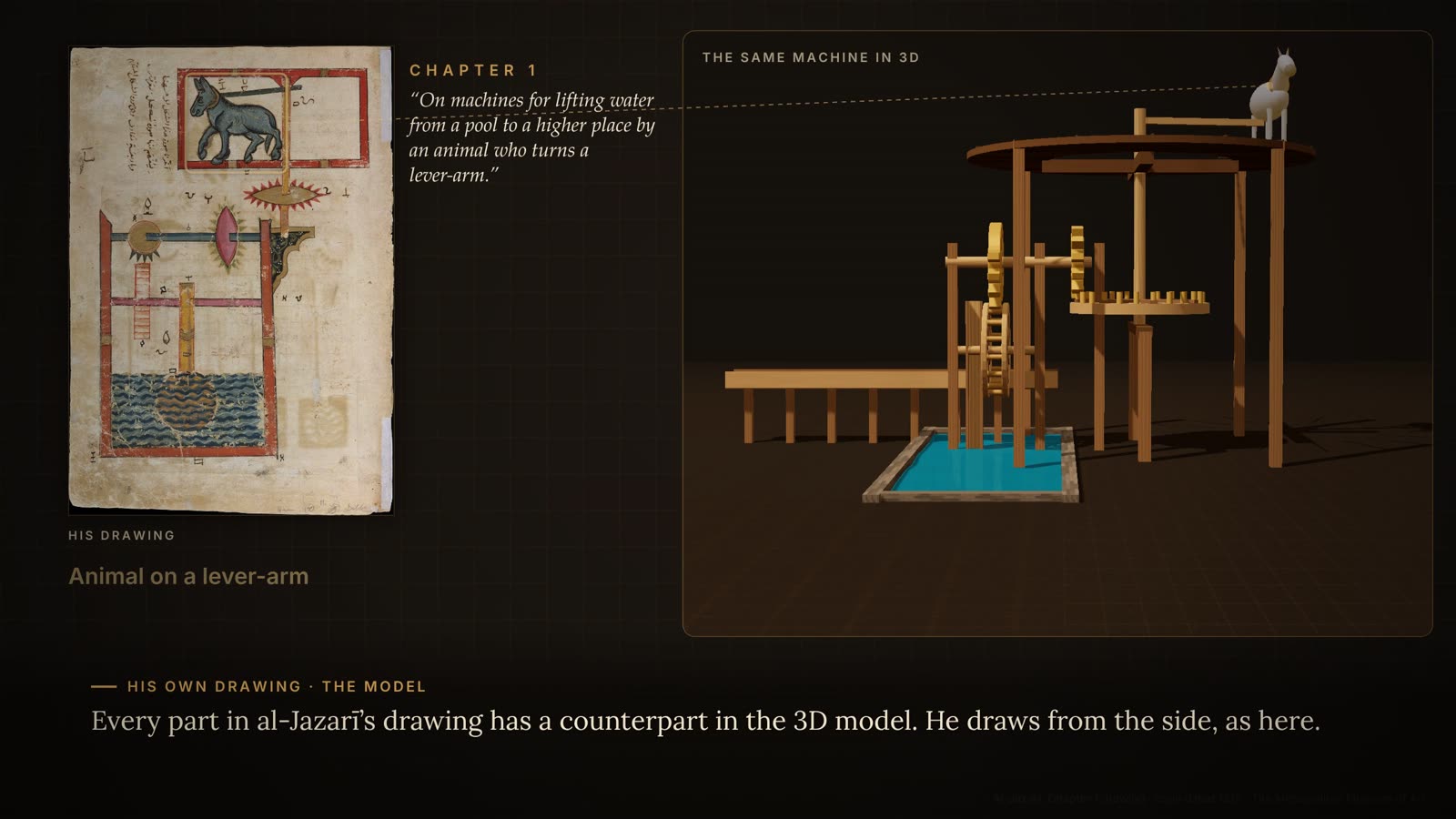
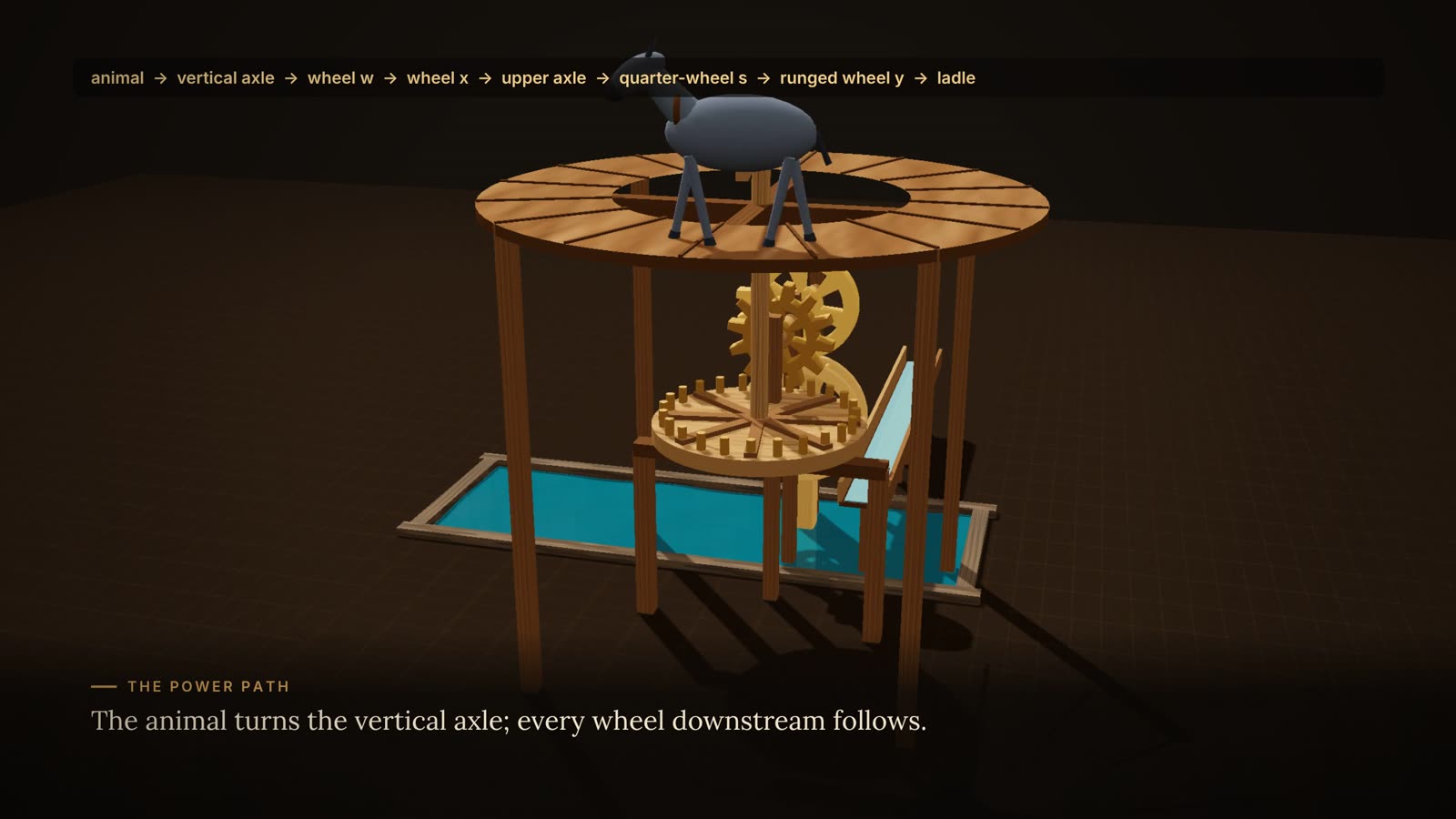
Al-Jazarī drew his machine from the side, with wheels shown flat or edge-on. Every part carries a letter, and the 3D model below reproduces each of them in place.
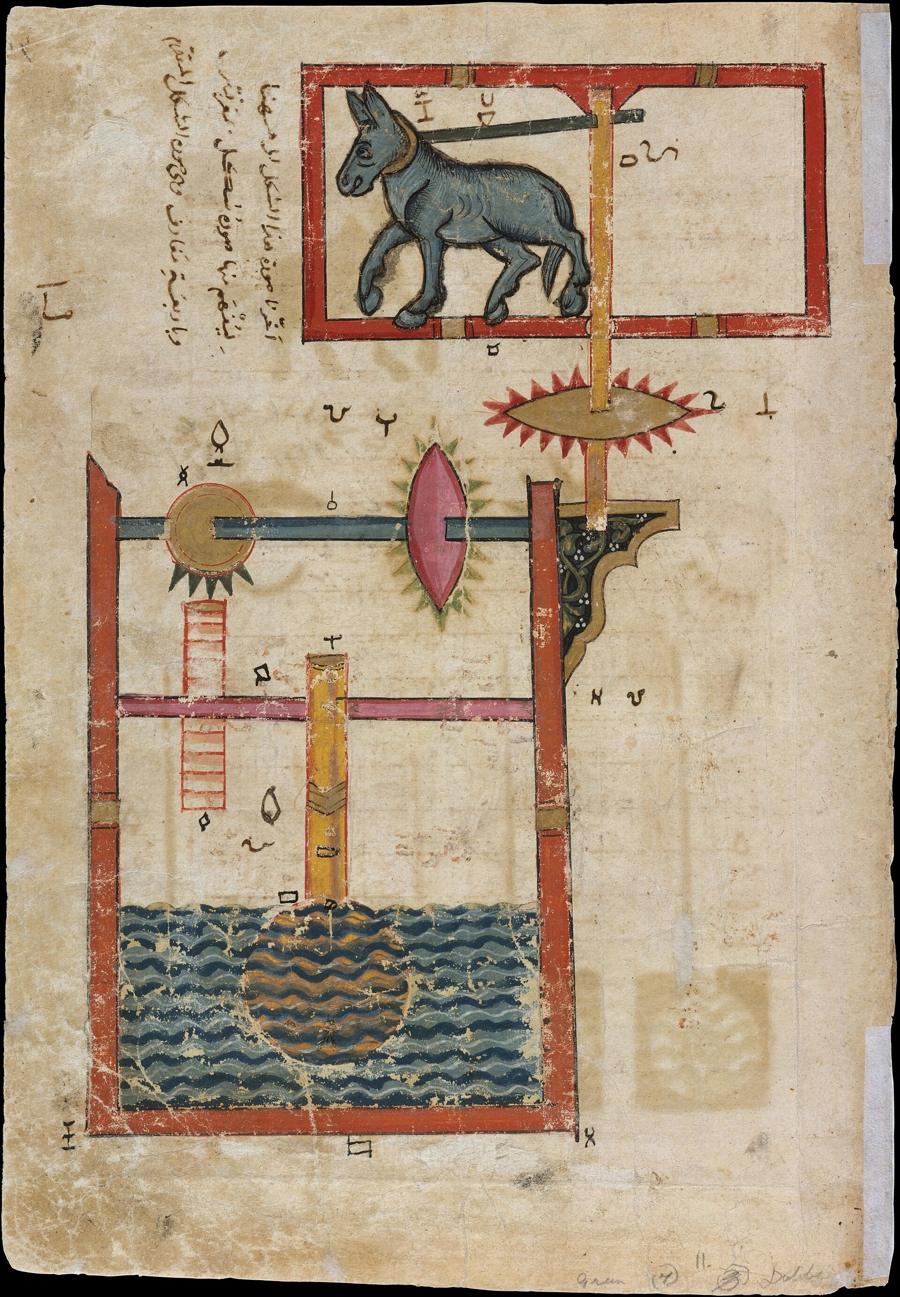
| Part | What it does |
|---|---|
| j | The lever-arm. An animal on the upper deck walks a circle pushing it, turning the vertical axle. |
| w | A flat wheel with pegs, fixed to the foot of the vertical axle. |
| x | An upright toothed wheel on the end of the upper (horizontal) axle. The pegs of w catch its teeth, turning the motion through a right angle. |
| s | The quarter-wheel, also on the upper axle: teeth on only one quarter of its rim, spaced like the rungs of y. |
| y | A runged (lantern) wheel on the lower axle. In the side-on drawing it looks like a ladder. |
| — | The ladle, fixed to the lower axle, with a scoop in the pool and a hollow stem that doubles as a channel. |
How the quarter gear works
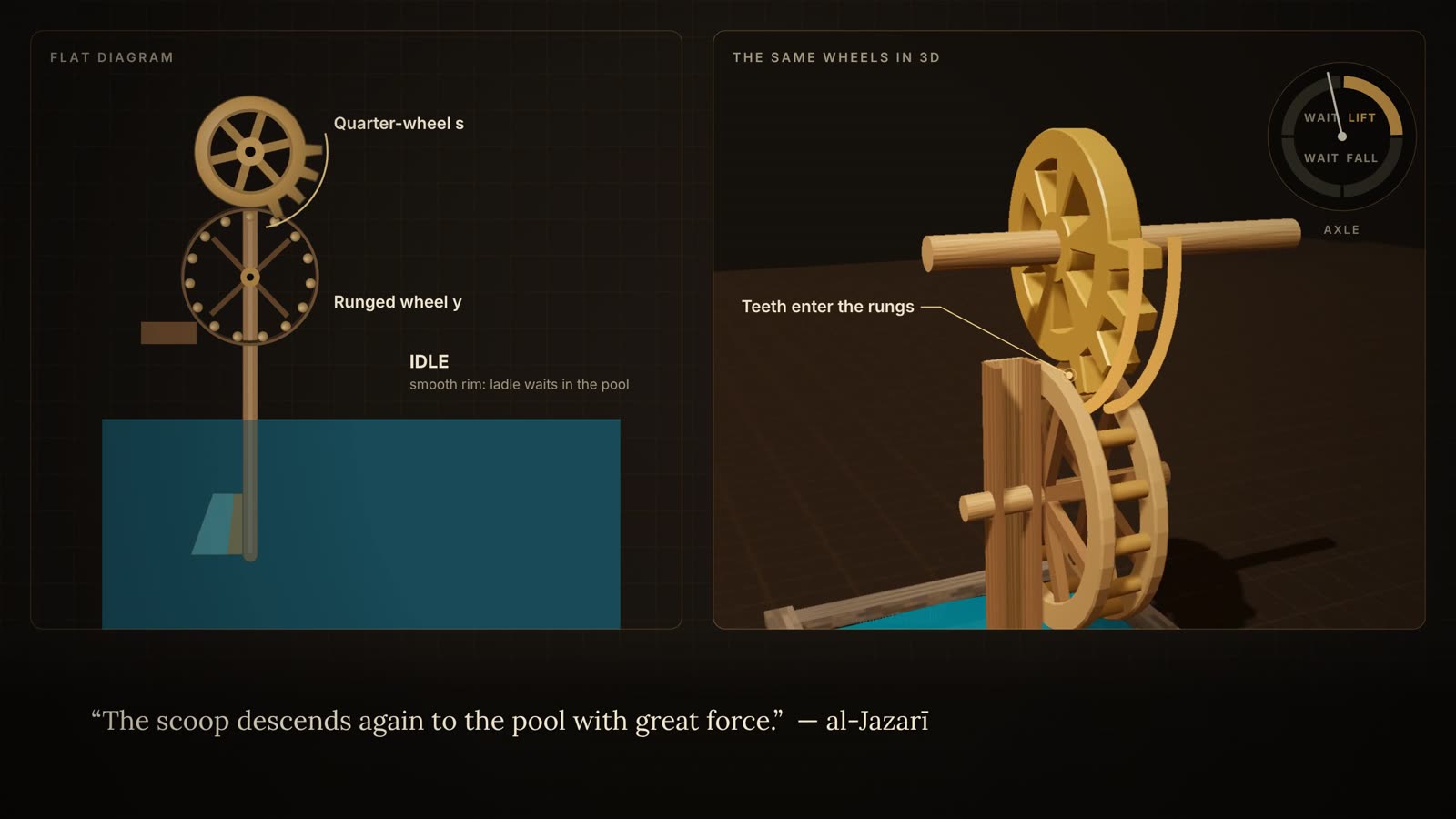
The heart of the machine is the quarter-wheel, what engineers today call a segmental or partial gear. While its few teeth pass through the rungs of wheel y, the lower axle turns and the ladle swings up out of the pool. As soon as the last tooth slips free, nothing holds it, and in al-Jazarī's words:
“The scoop descends again to the pool with great force.”al-Jazarī, Book of Knowledge, Category V, Chapter 1
The ladle then waits in the water for the remaining three quarters of the turn, until the first tooth comes round again.
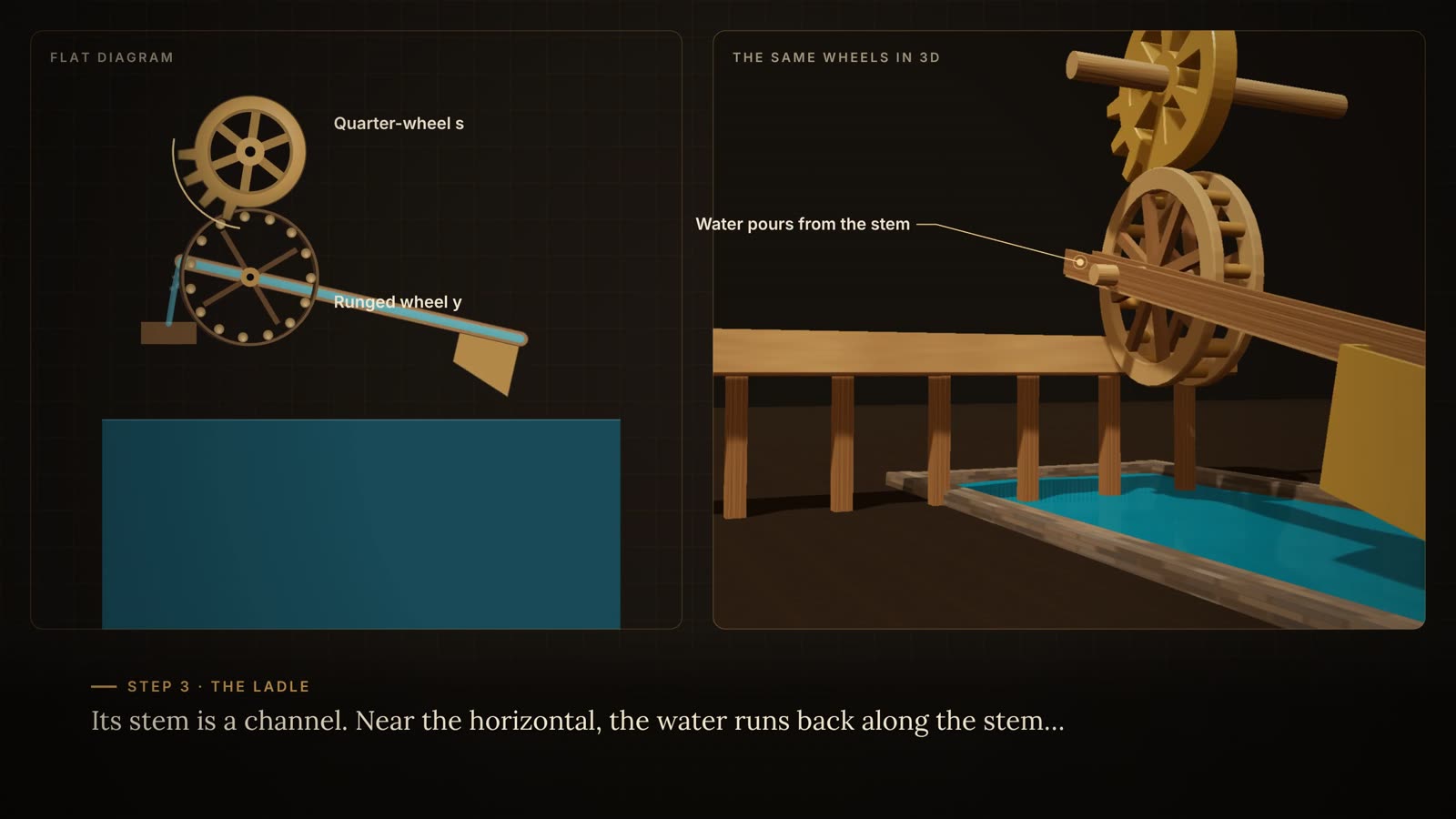
The ladle's stem is itself a channel. As the scoop rises past the horizontal, the water runs back along the stem and pours out of its end into an irrigation channel set higher than the pool. Al-Jazarī gives the scoop's capacity as about 30 Baghdadi raṭls, roughly 12 litres.
The problem: one lift per turn
One quarter-wheel means one discharge per turn of the upper axle, followed by three quarters of a turn in which no water arrives. The animal feels it too: a heavy pull while the ladle lifts, then nothing, then the heavy pull again.
Chapter 2: four quarter-wheels on one axle
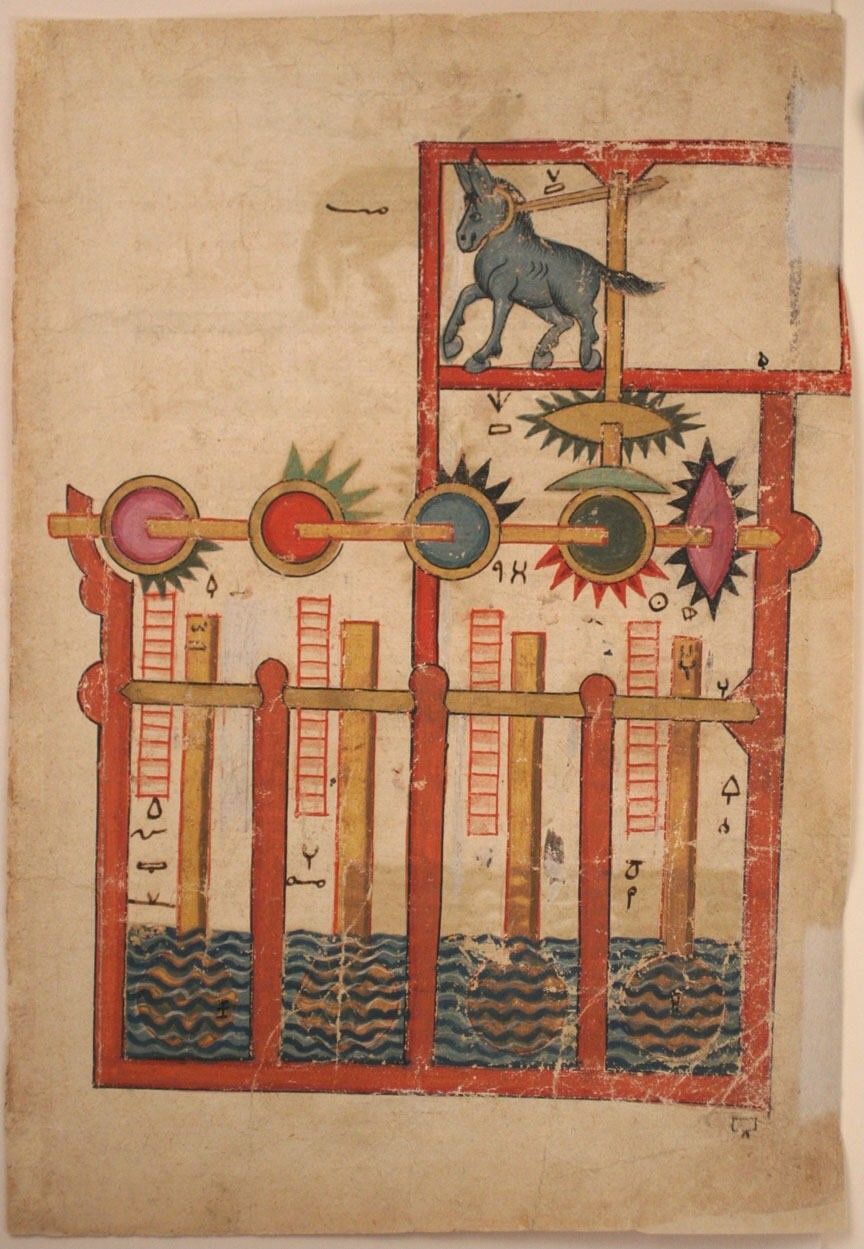
Al-Jazarī's answer was to give the same upper axle more quarter-wheels, each driving its own runged wheel and ladle. Look closely at his Chapter 2 drawing: the teeth on each of the four wheels are set at a different place on the rim.
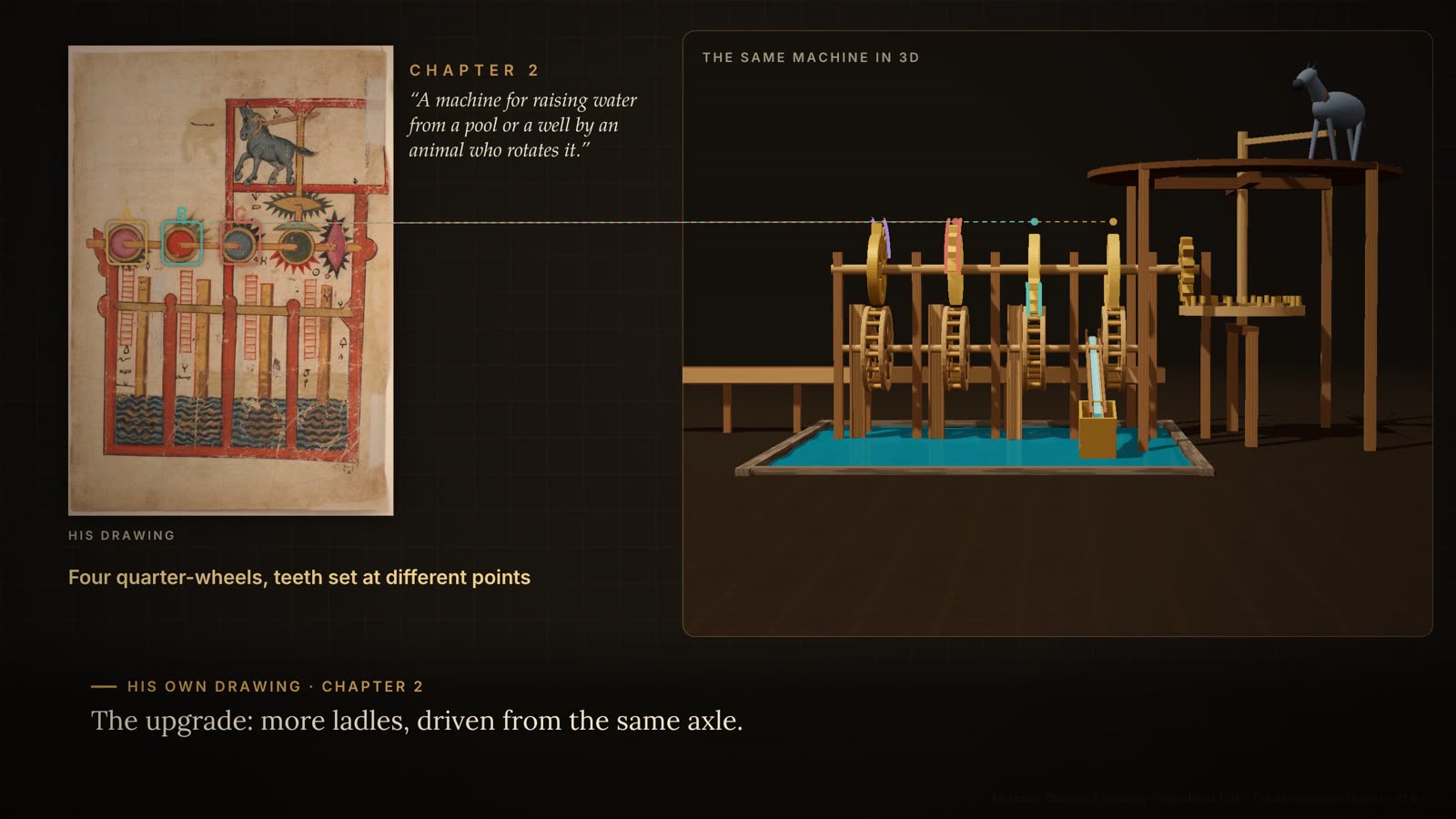
- Two ladles, a quarter-turn apart, cut the idle time from three quarters of a turn to half.
- Four ladles, each with its teeth a quarter-turn round from the last, leave no idle time at all. As one ladle lets go and falls, the next wheel's first tooth takes hold: A, then B, then C, then D, and A again.
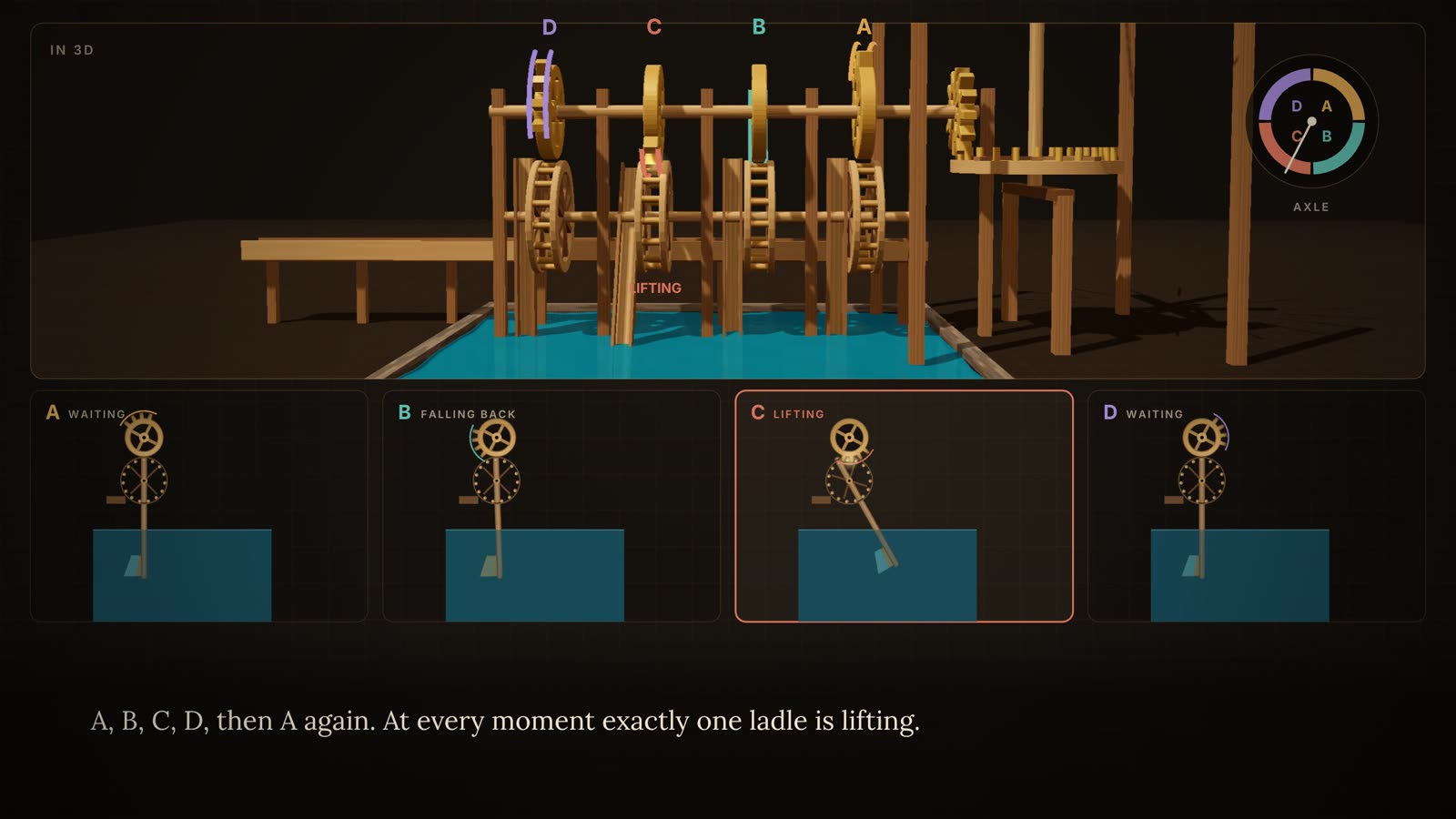
“Self-regulating at a single weight: neither lighter nor heavier than what is required.”al-Jazarī, on the four-ladle machine
The result is four pourings per turn instead of one, a channel that never runs dry, and an animal that pulls one steady load: never idle, never straining.
Partial gears after al-Jazarī
Gears with teeth on only part of their rim appear clearly in al-Jazarī's book. In Europe they surface in Giovanni de' Dondi's astronomical clock of 1364 and become common in machine design only around 1500, almost three centuries after him.
Watch the film
The six-minute film walks through both chapters with his drawings, the 3D model and narration.
Chapters
0:00Intro: al-Jazari's Book of Knowledge (1206)0:42Before al-Jazari: the shaduf1:05Chapter 1: his drawing and the machine in 3D1:41Following the power: from the animal to the ladle2:04The quarter-wheel meets the runged wheel2:24The fall: "with great force"2:44The ladle that is also a channel3:06The problem: idle time and an uneven load3:25Chapter 2: four quarter-wheels on one axle3:45Two ladles, then four4:24"Self-regulating at a single weight"5:22Partial gears after al-Jazari5:55More machines
Questions & answers
What is a quarter gear?
A quarter gear (also called a segmental or partial gear) is a toothed wheel with teeth on only part of its rim. In al-Jazarī's machine the "quarter-wheel" has teeth on one quarter of its circumference, so it drives the wheel below it for a quarter of each turn and then lets it go. That on–off motion lifts a ladle full of water and then lets it fall back into the pool.
Who was al-Jazari?
Ismāʿīl ibn al-Razzāz al-Jazarī (1136–1206) was an engineer who spent some twenty-five years in the service of the Artuqid rulers of Diyar Bakr, at Amid (today's Diyarbakır). In 1206 he completed the Book of Knowledge of Ingenious Mechanical Devices, describing fifty machines he had built himself.
What is the Book of Knowledge of Ingenious Mechanical Devices?
Al-Jazarī's treatise, in Arabic Kitāb fī maʿrifat al-ḥiyal al-handasiyya, is a practical engineering manual from 1206. It is divided into six categories: water clocks and candle clocks, drinking vessels and automata, devices for hand-washing and phlebotomy, fountains and musical automata, machines for raising water, and miscellaneous devices such as doors and locks. Each machine has a drawing labelled with letters and step-by-step building instructions.
How much water did the machine lift?
Al-Jazarī says each scoop of the ladle holds about 30 Baghdadi raṭls, roughly 12 litres. The single-ladle machine of Chapter 1 delivers one scoop per turn of the upper axle; the four-ladle machine of Chapter 2 delivers four, one in each quarter of the turn.
Why did al-Jazari use four quarter-wheels?
With one quarter-wheel, the ladle only lifts for a quarter of each turn and the animal pulls a heavy load followed by no load at all. By setting four quarter-wheels on the same axle, each with its teeth a quarter-turn round from the last, one ladle is always rising. Water reaches the channel four times per turn and the animal pulls a steady load, which al-Jazarī describes as "self-regulating at a single weight".
Is this a water wheel or a saqiya?
It is an animal-powered water-raising machine related to both the shaduf (a counterweighted lifting pole) and the saqiya (an animal-driven gear and wheel). It keeps the swinging ladle of the shaduf but drives it from an animal walking in a circle, through a train of gears ending in the quarter-wheel.
Where can I see the original drawings?
Folios from a copy of al-Jazarī's book dated 1315 (AH 715) are held in several collections, including The Metropolitan Museum of Art in New York, which publishes them as public-domain images. The Chapter 1 drawing on this page is Met accession 55.121.11.
Sources
- Ibn al-Razzāz al-Jazarī, Kitāb fī maʿrifat al-ḥiyal al-handasiyya (The Book of Knowledge of Ingenious Mechanical Devices), 1206, Category V, Chapters 1–2. Quotations are al-Jazarī's own words in English translation.
- Manuscript folio, Chapter 1: The Metropolitan Museum of Art, 55.121.11, copy dated 1315 (AH 715), public domain.
- Background: Ismail al-Jazari and The Book of Knowledge of Ingenious Mechanical Devices.
- The 3D model is a reconstruction from al-Jazarī's text; wheel sizes are illustrative.
Fifty machines, one master engineer
More of al-Jazarī's machines are on the way
Subscribe to follow each one as it is rebuilt and animated.